
First, let me say that I am not here to make you feel bad about your nicotine habit if you are currently smoking or vaping. While I’m adamant that quitting was the best decision I ever made, I don’t think you have anything to be ashamed of, whether you have tried and failed a million times, never tried, or don’t plan to stop.
This post celebrates my upcoming quit-iversary (November 4, 2011), shares some things I learned from my experience in case they’re in any way helpful to others, and links to some resources for folks who are considering taking this step.
Getting Hooked
Although my youngest niece was alive when I quit smoking, she does not recall that season of my life whatsoever. When I referenced it once, she was shocked to hear I’d been a smoker, a typical response from people who met me afterward. This is, in part, because I am nowadays extremely triggered by cigarette smoke and cannot tolerate being around it.

The other reason me being a long-time heavy smoker surprises people is because of how active I am between my love of hiking, biking, swimming, and typically being a regular exerciser. It’s hard to wrap my head around now, but I used to pause hikes and walks for a nicotine break. Or light up a ciggie immediately upon exiting the gym. Even at the time, doing something positive for my health and then segueing to a cancer stick struck me as absurd – but it is better to do the good thing for your health followed by the bad thing than to not do the good thing at all, right?
I wasn’t just a casual smoker. It wasn’t a weekend treat or limited to social occasions. I became a pack-a-day person at age 14. Nicotine is one of the most addictive substances that humankind has ever encountered, and one reason for that is that it’s also one of the most accessible. Yes, there are cost barriers, social stigma, and rules about where you can/can’t partake, all of which became more pronounced since I quit in 2011. Nonetheless, it’s still legal to smoke, easy to purchase cigarettes, and rarely impossible to find a place permissible to light up.
Another reason smoking is so easy to get hooked on and difficult to quit is because of the associations that smokers create between the habit and everyday life activities. I was someone who automatically followed each meal with one. Who needed one as soon as they woke up and right before they went to bed. One time, when I tried to quit, I did great for a few weeks; then, the first time I drove my car, I immediately caved and bought a pack because it felt impossible to take on the 2.5-hour trip without one. It becomes a ritual, which wires it into our brains as an expected activity anytime we perform the associated tasks.
This wiring is all the more stubborn and resistant to budging if you began your nicotine habit as a teenager. A four-decade study found that when young people start smoking, they’re more likely to develop higher levels of nicotine dependence and experience more challenges when kicking the habit than those who start later.
For folks who never smoked and find the habit disgusting, it’s easy to overlook another reality of cigarettes: they’re enjoyable! The nicotine in cigarettes releases several neurotransmitters in the brain, including dopamine. Dopamine promotes positive feelings and also helps to reduce negative feelings caused by stress. This chemical aspect of the habit is especially relevant to folks with mental health issues and disorders that result in lower levels of dopamine in their system, such as people with depression or ADHD.
“Within seconds of inhaling cigarette smoke or vape mist, or using chewing tobacco, nicotine causes the release of dopamine in the brain, which gives people a good feeling. Over time, the brain begins to crave that feeling from nicotine and people need to use more and more tobacco to get that same good feeling.”
Northwest Territories Health and Human Services
Another pleasant thing many smokers benefit from is doing something healthy that many of us are not good at or don’t get many chances to do: taking a break! I once tried to quit but didn’t tell anyone I worked with so I could continue to take smoke breaks. I even went so far as to keep cigarettes with me and light one up to hold onto so there were no questions about why I was stepping away from the sales floor every couple of hours, which was otherwise disallowed even if labor laws said otherwise.
While the habit is more frowned upon today, there are also the lovely social aspects. Asking for a lighter, bumming a cigarette, telling someone to enjoy their break, finally striking up a chat with a familiar face who is on a similar schedule, and other random smoking-related interactions can all lead to new connections. In my first year of college, I made most of my friends not in class or clubs or social settings, but rather in an area outside of the dorms referred to as “The Ashtray.”
It’s Not All Good
Although there was much that I enjoyed about the habit, there are obviously plenty of problematic aspects. There’s an overwhelming amount of literature detailing the many negatives of smoking, so I won’t belabor pointing out that it can result in cancer, emphysema, COPD, or contribute to other disorders. But health impacts aside, there were plenty of other reasons that I wanted to quit, which included:
- Smell: I was one of the folks in Pittsburgh who didn’t mind when the law began requiring most establishments to prohibit indoor smoking. Although I did smoke in my car and apartments, I never enjoyed the reek it left behind, and I became more sensitive to it as time went on.
- Teeth-staining: As a heavy smoker and coffee drinker, I became self-conscious about my teeth’s yellow hue in my 20s. Once I finally quit, I treated myself to a bleaching treatment.
- Compromised immune functioning: While I was a smoker, I seemed to catch every freaking cold and flu that came my way. On top of how often I got sick, I stayed ill longer than other folks with coughs that I could not shake. I tried to reduce my smoking while unwell, but if ever proof of my level of addiction was evident, it came while lightly huffing a cigarette while battling pneumonia, hacking and coughing the whole time.
- Morning discomfort: When you quit smoking for even a few hours, your cilia get to work on expelling the toxins in your body, which results in the morning cough that many smokers have. I often arose feeling like two hands were tightly gripping my lungs, preventing them from fully expanding. You’d think this unpleasant start to the day would have prompted a change sooner for me, but addiction is a helluva thing.
- Tension when unable to smoke: I dreaded flights as a smoker, especially as more airports eliminated indoor smoking sections. As a barista, I would sometimes get downright angry if a customer approached the coffee counter during my breaks, causing me to snuff out my smokey treat and rush inside.
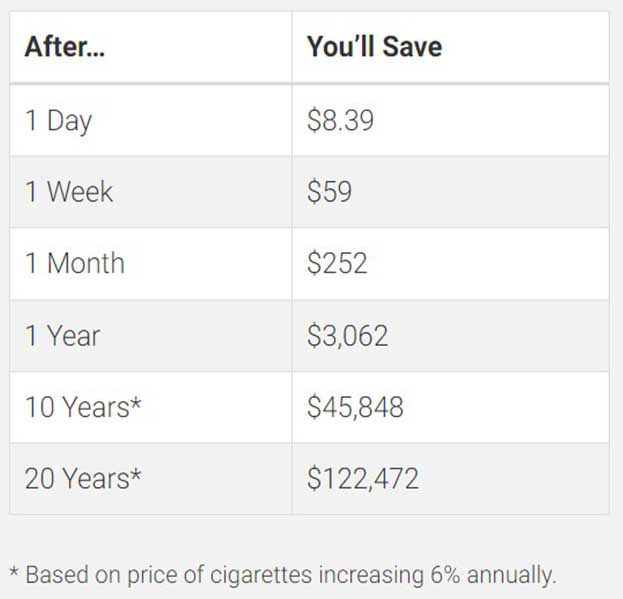
- Cost: When I started smoking, a pack was only about $2. By the time I quit, they ranged closer to $6. When I see the prices these days, I wonder how anyone can afford it!

Finally Saying Goodbye
I tried unsuccessfully to quit a few times during college, mainly motivated by a desire to save money. By my mid-20s, I felt so discouraged by these failed attempts that I gave up entertaining the notion.
A friend studying medicine joked that she wouldn’t give me a hard time about the habit until I turned 30, then the lectures would begin because I would start doing irreversible damage to my lungs at that point. While this didn’t motivate me to quit, the fact stayed in my mind.
When I reached 28, I still wasn’t considering quitting until a random turn of events arose: I broke a tooth. When I scheduled the extraction, I learned that the procedure is similar to having wisdom teeth removed and can result in a dry socket if you smoke within three days.
I was already terrified of the removal, but even more of the horrors I’d heard about dry sockets, so I knew that somehow I would have to quit for at least those three days. But I was also aware that your body depletes nicotine entirely from your body within three days, meaning after that, it’s psychological addiction that you’re battling. It seemed like getting the most difficult part over with already would make it silly to start back up, especially with age 30 looming.
Although I began to give serious thought to quitting for good, I didn’t tell anyone. I didn’t even commit that goal to myself. I was so anxious about the dental procedure that I focused only on that and my resolve to at least make it those initial three days.
When my ex-husband dropped me off at the office for the extraction, I had a cigarette anxiously clutched in my hand. He gently asked what I planned to do about smoking. He was surprised when I told him this may be the end of my time as a smoker. But thankfully, he didn’t press further on the topic and just sent me on my way with good wishes for the appointment. I huffed down two back-to-back before heading inside, tossing what was left of the pack into the trash on the way in with the thought that if I changed my mind, I could always buy another pack in a few days.
The first three days went smoothly. I have typically found that when I know I can’t do something, like it’s not even an option, it’s much easier to abstain than when I must actively choose to forego doing it. This is undoubtedly true with sweets; I struggle to resist binging on them if I have a stockpile available but barely think about them or lament their absence otherwise. So, as I laid around loaded up on pain meds, icing my aching jaw, and gingerly eating soft foods, I kept the urges easily at bay.
Things got a bit tougher on day four when I had to consciously decide whether I was truly quitting. I reassured myself multiple times throughout the day that the hard part was over; I already beat physical addiction. I told myself every time I considered caving that “You’d have to be a real asshole to start again now. You got this.”
I forget which day it happened, but I eventually sat down and made a one-page document laying out all of the reasons I wanted to quit. I included the cost of smoking per week, month, and year and noted how much other cool stuff I could use that money for instead. I listed the scariest health risks, documented the discomfort of those morning coughs, and lamented my struggles climbing hills on hikes and bike rides, etc. The most compelling argument was a desire to show my nieces and nephew how hard and worthwhile it was to quit and to model healthier behavior for them, especially since my oldest niece was approaching the age that I was when I started.
I printed it out, folded it up, and kept it with me at all times. I busted it out as a reminder anytime I felt strong urges. During an especially tough moment, I handwrote an additional point of encouragement with all caps in the margin:
IF YOU DO THIS, YOU CAN DO ANYTHING!
I also made a deal with myself: for the first year, I would take every single dollar saved and use it at the end of each month to treat myself to something that I otherwise would not splurge on. This positive reinforcement resulted in massages, facials, and manicures galore, all of which I delighted in. I felt giddy each time I scheduled the appointments and thanked myself repeatedly before and after.
Although I no longer reward myself with unspent ciggie money, I do still calculate the savings each year on my quit-iversary and give myself an enthusiastic pat on the back.
So far, I’m up to nearly $35,000!
The first month was not without its challenges, but I could “surf the urge” more easily than I experienced the first few times I tried to quit. I attribute this to the fact that I was more committed this time; when the desire for a cigarette arose, I felt resolute that it wasn’t going to happen and I just had to get over it. Somehow, that sense that there was no debating the matter helped push it out of my head more effectively and limited obsessing.
My worst withdrawal symptom, insomnia, came as a surprise, although I later learned that sleep disruptions are pretty common. I had no trouble falling asleep, but I’d find myself wide awake as little as three or four hours later. For the first couple of days, I tried futilely to get back to sleep. I would lay in bed periodically checking the clock in desperation to get at least a couple more hours in before work. Eventually, I began to accept the situation and use the extra time and nervous energy for projects around the house, such as scrubbing the baseboards and cleaning the ceiling fans.
If memory serves, this lasted about a month. I felt utterly unhinged by week three. But I also remember being grateful that it wasn’t a symptom that made me desire a cigarette because it’s not like I had an association in mind that the cure to insomnia was smoking. Unpleasant as it was, sleep deprivation wasn’t a trigger and didn’t make it harder to continue resisting.
By the end of the first month, I felt more confident about the change sticking and began to tell people I’d quit smoking. This marked a shift in my perceived identity, which I now know is one of the most effective abstinence strategies — telling people I was a non-smoker helped manifest me being a non-smoker.
I had a few vulnerable moments out at concerts and social occasions early on in the process when I encountered people smoking and reminisced. But it didn’t take long before their smell began to gross me out and now it makes me cough and causes red bumps on my face. I can’t even imagine what would happen if I tried to smoke one today, and I’m okay with never finding out.
What I Wish I’d Known
Although my final attempt was successful, I’ve learned a lot since then about strategies to make cessation easier. Below are some things I wish I’d known sooner or thought through more ahead of time:
- Most people try quitting multiple times before it sticks. Recent studies have shown that the average attempts may number as many as 30. If I’d realized this, I might not have felt so discouraged by failing a handful of times and tried again sooner.
- Cutting back first helps to lower the amount of nicotine in your system and thus reduces the severity of withdrawal symptoms.
- You can set yourself up for success by breaking your associations ahead of time, e.g., forego post-dinner cigarettes, smoking at the bus stop, and so on, even before you quit. This will help you be less triggered by day-to-day cues when the time for elimination arrives.
- Also, plan ahead by developing other coping strategies. How will you self-soothe the next time you get into an argument with someone if you can’t turn to a cigarette to calm down? What will you do on breaks to relax and restore during the workday? How will you manage encounters with smokers in social situations?
- Withdrawal symptoms don’t just look like a desire to smoke or being grumpy, so do some research and be prepared. If I’d done this, my insomnia would not have been a surprise. Difficulty concentrating and increased hunger are also likely.
Resources
I’m no expert on cessation; this is just my personal account about quitting. Below are many other resources you may find helpful if you’re considering making this change:
- The CDC has a lot of great info, including this page about the benefits of quitting.
- Positive rewards are often a better incentive to change behavior than thinking about scary health risks or other negative aspects of continuing to smoke, so here’s an overview of the changes in your body when quitting, some of which begin on the very first day!
- Being clear on your motivation will help you stay focused on the goal, so here is a list of 100+ reasons to quit.
- It’s helpful to understand what to expect when you quit so you aren’t blindsided by withdrawal symptoms like I was with insomnia, so here’s a good overview of those.
- This National Cancer Institute list of common triggers offers tips for managing encounters with them.
- This overview of the scientific model of behavioral changes called the “Stages of Change” may help you understand the different phases, identify where you are, and track your progress.
- The SmokeFree.gov calculator allows you to see how much money you can save by quitting, plus there’s loads of other useful stuff on their site.
Please know that while it’s not easy to quit, it’s probably not as difficult as you expect. You can do it!
I am more than happy to connect with anyone needing encouragement. Please feel free to drop me a line using the Contact form, email hello@hezhub.com, or leave a comment below.
 hezhub.com
One thought on “Why I Know I Am Capable of Anything”