The Academy of American Poets began National Poetry Month in 1996. I’m stoked to join in the festivities this year, which further proves that I’m making strides in defeating my imposter syndrome as a poet.
I like to say that I became a poet by accident. In 2021, I was going through a tough time, and somewhere in the midst of it, I began scribbling little stanzas on scrap paper. I didn’t know where the inspiration came from because I’d never attempted to write poems before. In fact, I didn’t even like poetry that much. I’d read a few that struck a chord with me, but for the most part, I didn’t feel drawn to it or have poetry books in my reading rotation. My single attempt at taking a poetry course in college as part of my English major frustrated me with the tedium of analyzing poems. One particular selection annoyed me so much that a classmate and I wound up ripping that page out of our textbook and burning it after we completed the class discussion about it.
In spite of this past ambivalence, the scribblings kept pouring out of me—sometimes just a few lines, occasionally twenty. Some days, I’d ask myself what was happening—why was I writing poetry? But I had no answer, no voice inside that confessed to having secretly always wanted to be a poet. I just went with it, and eventually, the scraps of paper grew into a rather unwieldy stack, so I decided a poetry notebook was in order.
Around the same time as this upgrade, I began checking out poetry books from the library. I started with Adrienne Rich and found myself often sobbing as I flipped through her anthology. I revisited collections written by a friend that I’d initially bought simply to be supportive and found that the words were sinking into a different dimension of understanding and appreciation.
On one visit to the library, I struggled to find a particular title, so the guy at the Information Desk joined my search. I joked about being so new to poetry that I couldn’t even figure out how to locate the dang books on the shelves. He noticed my other selections were about meditation. He commented that poetry and mindfulness seem to go hand in hand, so maybe that’s why I was drawn toward it. An interesting observation, I thought.
In July of 2021, I felt inspired to resuscitate my other writing talents and began to pick at some nonfiction pieces. I hadn’t written anything outside of work-related content since finishing college in 2005 and finding any flow was arduous. For that reason, when I had writing time blocked on my calendar, I’d often wind up cranking out more and more poems as a diversion to whatever story or narrative I was supposed to be working on. Sort of like that whole cleaning your room to avoid doing your homework approach.
This trend continued for months, yet despite writing multiple poems daily, I still didn’t feel like I was achieving my goal of being a writer because I wasn’t creating nonfiction or fiction regularly. But I didn’t feel like a poet either because although I was producing many pages of poetry, it felt like garbage. I also recognized it as a diversion of sorts.
Eventually, things began to shift, though. One day, I wrote a poem, read it back to myself, and thought, “Wait a minute–I think that’s good? Is that good? That can’t possibly be good, right?” I began to have that experience more often, usually not with complete poems, but a line or two would stick out as actually having some promise.
Then, I read James Clear’s book, Atomic Habits, and learned about the value of repetition. We all know that the more you do something, the better you get at it. Still, given my situation, the example he shared about a university photography course resonated. The students were divided into two groups: the first would focus on quantity and be graded by how many photos they took; the second would learn as much as possible about theory and strategies, which would be used to inform their work on a single photo to submit. It turned out that all of the best images were taken by the “quantity” group, who were hands-on experimenting, testing different approaches, and learning from their output as they went along.
A similar mechanism seemed at play with my writing output. With fiction and nonfiction, I was so caught up in how to craft what I wanted to write, what sort of writing practice I needed to develop, and beating myself up for not making enough progress that I fell into the trap that James Clear so aptly described: “We are so focused on figuring out the best approach that we never get around to taking action. As Voltaire once wrote, ‘The best is the enemy of the good.'”
On the other hand, my poetry was under very little pressure. I didn’t think I was a good poet, and I was not invested to the same extent in becoming one. I didn’t even have plans to share my poetry. I just made space for the practice without any expectations, and it naturally began to improve.
“It’s not the quest to achieve one perfect goal that makes you better, it’s the skills you develop from doing a volume of work.
James clear
In other words, when you think about your goals, don’t just consider the outcome you want. Focus on the repetitions that lead to that place. Focus on the piles of work that come before the success. Focus on the hundreds of ceramic pots that come before the masterpiece.”
With this new appreciation for the simplicity of continually writing poetry in order to create better poems, I committed to writing at least two poems every day. Most mornings, my poetry notebook is the first thing I grab once a cup of tea is in hand. By the summer of 2022, I felt confident enough in a small collection of pieces that I decided to share them with a handful of friends for input about which, if any, seemed strong enough to attempt publishing.
With their helpful feedback and votes of confidence, I attended my first poetry open mic hosted by Melodic Movement at the Mudita Café in Arlington, Virginia. Overcoming my anxiety to read original works aloud to an intimate audience was no small feat. However, most of the folks present were also poets who planned to read, which made for a very supportive audience.
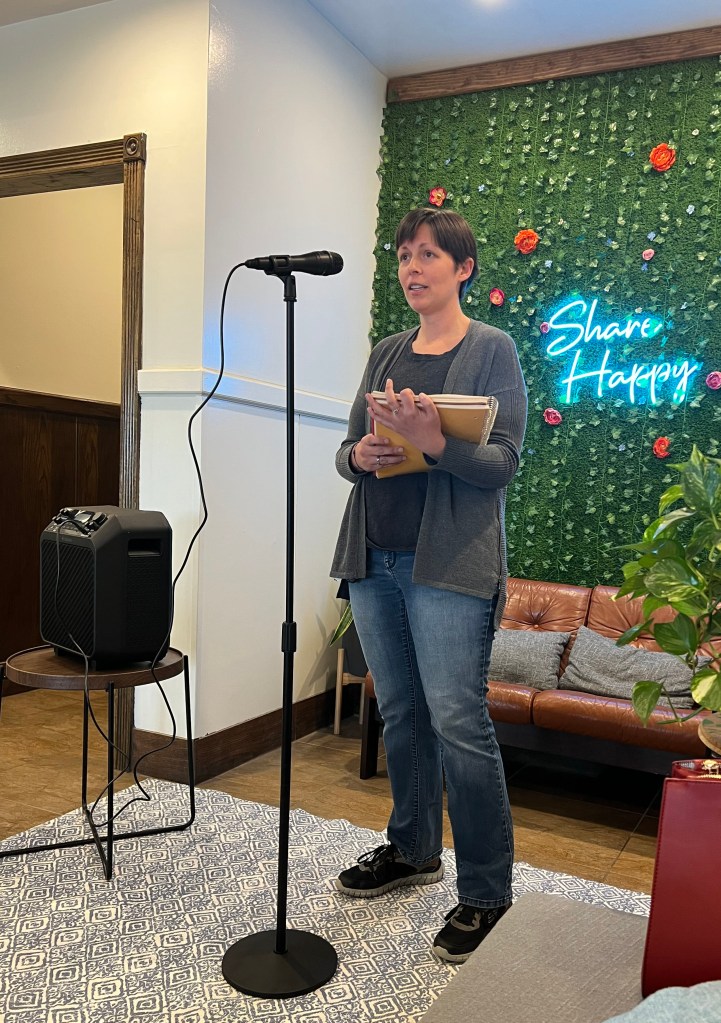
Buoyed by the positive experience in Virginia, I decided to suck it up and include a few selections on this website’s “Writing” page despite still feeling like a bit of an imposter pretending to be a poet. Midway through the year, I took another big-for-me step and submitted a few poems to Trailer Park Quarterly for consideration. Much to my delight, one was accepted, and in late 2023, I officially became a published poet with “Diviertas en tus Vacaciones!”
In the months since then, I’ve more actively sought out opportunities to further develop the craft. I joined Philly Poetic Resistance, which is a (mostly virtual) poetry-sharing group. The organizers identify optional monthly themes that provide a fun challenge to play around with, and the group’s members are incredibly affirming.
I’ve also begun attending more poetry events, including readings by other poets and a recent amazing presentation about strategies for editing poems. I’m also excited to now have two writing buddies with whom I regularly check in with for accountability and to workshop drafts.
I may never be able to quit my day job or even make a single cent as a working poet, but I’m glad I’ve continued to make space for this art form, and I am grateful for the awesome people I’ve met so far as a result. I am confident that I will continue to improve and get even more satisfaction from this journey from here on out.
This April, I plan to celebrate National Poetry Month on my website and social media pages, so keep an eye out for poems by myself and folks whose work I admire. You can also visit the American Poets Society for ideas about how you can celebrate.
 hezhub.com
2 thoughts on “Happy National Poetry Month!”