
As I wrote about in the “Relief of a Diagnosis” series, my neuropsychological evaluation in the summer of 2023 confirmed that I had ADHD and Unspecified Trauma- or Stress-related Disorder. Still, it left open the question of whether I may be autistic, bipolar, neither, or both. In this post, I describe ways I explored the possibility of Autism Spectrum Disorder (ASD) in the 10 months since getting the results.
Pooling Resources
As a constant learner, I immediately turned to the library and the internet to review countless books, articles, podcasts, and more to learn more about ASD and its interplay with ADHD. In a future blog post, I will share a list of these for anyone interested.
A key takeaway was that until recently, having an ASD diagnosis precluded receiving an ADHD diagnosis and vice-versa; the myth that it was impossible to have both is now thoroughly debunked. It turns out that there’s actually a significant number of folks with comorbidity of the two disorders. The estimates of a dual diagnosis vary, but some figures commonly circulating suggest that 20-50% of people with ADHD also have ASD, and 40-70% of people with ASD have ADHD. While more research is needed to explain why this is, overlapping contributing genetic factors have become well-documented and may be a factor.
While approximately 10% of the population has ADHD, some research has shown that 40% of autistic people have ADHD, with other studies suggesting that the rate may be closer to 70%.
Amy Marshall, PsyD
Conversely, while 2-3% of people are autistic, 20-50% of those with ADHD are also autistic.
Talking to Family and Peers
In neurodiverse (ND) communities, it is often joked that we have radar that attracts us to other ND folks. Many memes suggest that if you are friends with a bunch of people who have ADHD, ASD, etc, it’s probably time to seek your own diagnosis. While science doesn’t entirely back this up just yet, there is research about how neurodivergents relate in social settings that suggests we may find more symmetry and common ground in our communication style that can facilitate forming bonds more quickly than we experience with neurotypicals.
Regardless of this claim’s validity, I have discovered a growing number of NDs within my network. A few (all boys) were diagnosed in childhood, but most flew under the radar into adulthood like myself. I also have several relatives on both sides of my family who are diagnosed with ADHD, a handful of whom suspect they are also autistic.
Eventually, I found a few online communities and support groups that connected me with even more NDs (a list of these will also be included in a future post). While learning about ASD traits in books and so on was undoubtedly helpful, it was comparing my life experiences with these folks and hearing about their journey to an ASD diagnosis that tipped me over into finding the prospect reasonably likely that I was autistic.
Professional Help and Self-Assessments
After months of research, exploration, conversation, and soul-searching, I felt pretty confident I had ASD. I spoke with my therapist and Primary Care Physician throughout this period about my observations and received positive feedback about my thought process.
When I expressed an interest in establishing a bit more certainty, my therapist provided an extensive list of free online self-assessments that mirror the instruments used by psychiatrists and neuroscientists in the field (yet another list to look forward to in an upcoming post). She suggested that while I did not need consistent results from every single one identifying me as over the threshold for suspected ASD, there should at least be a considerable trend of results heading in that direction.
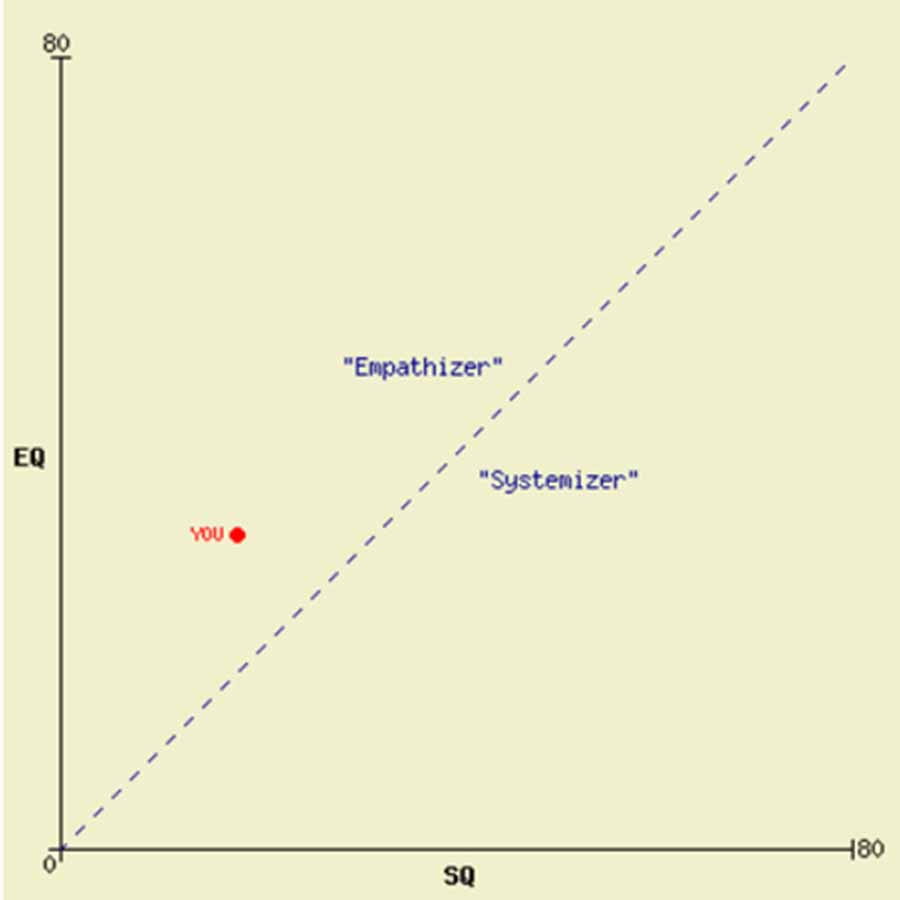
I spent a few weeks diligently taking each of these, and here’s what I learned: it appears that I’m not just mildly, or even moderately, autistic – I’m very freaking autistic!
Not only did every single one of the assessments place me above the threshold for suspected ASD, but many identified me as displaying significantly more than average amounts of autistic traits. For example, the Aspie Quiz resulted in a 98% probability of being autistic. The Ritvo Autism Asperger Diagnostic Scale-Revised (RAADS-R) deems any score greater than 65.0 as worthy of considering an ASD diagnosis; my score was 164.0. Not only did I crush the threshold, but this score is even higher than the average score for females diagnosed with ASD (160.5).
The various benchmarks of my assessments align with the findings of my neurospych eval testing, which documented my responses as being “significantly above established thresholds consistent with Autism Spectrum Disorder-related symptoms.” Further, several aspects of my self-reporting reflected sensory motor issues, social anxiety, an interpersonal style that may be somewhat distant, and circumscribed interests (restricted and repetitive behaviors that occur commonly in individuals with ASD).
Moving Forward
Autism is widely misunderstood. Until I began to learn more about it, I never would have guessed I had it. Now I am equipped with far more information, oodles of assessment results backing up the suspected diagnosis, and the encouragement of my care team validating my suspicions.
Despite my now high confidence that I am autistic, I’ve decided not to pursue a formal diagnosis further. Instead, I am choosing to self-determine my diagnosis and plans for how to manage the condition. In a future post, I will explain why I settled on this path forward and the input/feedback I received from my therapist.
 hezhub.com
Heather, Good investigating and insight into ASD. Hope you are finding some help with these issues. Aunt Jane
LikeLiked by 1 person
Definitely adapting to it much better now that I have more understanding. Thank you, Jane!
LikeLike