
In the first two installments of this mini-series, I shared why I got a neuropsychological evaluation, explained what they assess, and described my experience having one. Part three shared the findings, which included two confirmed diagnoses (ADHD and Unspecified Trauma- and Stressor-related Disorder) and two additional potential diagnoses (Autism Spectrum Disorder [ASD] and/or Bipolar Disorder) recommended for my care team to consider pending further observation and treatment. In this installment, I unpack some of my initial processing and feelings from receiving this news.
This series is named “The Relief of a Diagnosis” because I immediately felt relief (and still do) from finally getting a more definitive professional analysis of what is (and may) be going on with my brain. Like G.I. Joe always said in the series of PSAs often aired on television during the 80s, “Now you know. And knowing is half the battle.”
However, mingled with the relief, there were other complex feelings and thoughts to wade through. Like many people finally getting a late diagnosis for a mental disorder they’ve been suffering from for a long time, I couldn’t help but think about all of the “what ifs.” If I’d grown up in an era when it wasn’t so unheard of for females to have ADHD or ASD and gotten diagnosed sooner, would I have struggled less throughout my lifetime? And assuming so, where would I be now instead of where I am? Would I have:
- experienced less depression, anxiety, and trauma?
- helped my countless relatives from younger generations get their diagnoses sooner and aided in navigating these disorders instead of vice versa?
- developed healthier relationships with friends, family, romantic partners, colleagues, and acquaintances over the years?
- dreamed bigger and accomplished more of my goals?
While my mindfulness practices taught me to be aware of these thoughts and not suppress them lest they take root further, I didn’t want to linger in them too long. I’ve always been pragmatic, so I wanted to focus on the present, direct my efforts toward the here and now, and prepare for the future. There is no going back; no benefit in lamenting the coulda, shoulda, woulda beens. I can’t change what happened, but I can develop strategies and skills now to lay the groundwork for a better future than the one I’d have otherwise had. Better late than never, y’know?
But before I could go into problem-solving and action mode, I knew there was other emotional work besides the occasional drifting into hypotheticals about days long gone by. The fact is, I had some potent trepidation; perhaps it is even fair to say I felt terror. While there were many tumultuous events, difficult circumstances, sources of instability, and unpleasant feelings weaved into my life, I always felt like I could rely on my brain and mental capabilities no matter what was happening. My intellect helped me make sense of and rationalize my experiences. It allowed me to learn, grow, and sink into any topic I felt passionate about with fervor. I truly enjoyed being a constant learner, which gave me purpose. I admittedly gained much of my self-concept from others’ validation and recognition of my intelligence as well.
My brain was also my greatest asset as I attempted to perform the nearly impossible feat of pulling myself up by my bootstraps, as they say. Growing up, I knew we had limited money. While I was encouraged to go to college from an early age, it was evident that I was on my own to figure out how to get there and pay for it. I pressured myself to maintain stellar grades at every level of my education, an aim that was nearly always realized. In countless other arenas of life, I also relied on my combined book smarts, social skills, creative thinking, discipline, and unwavering commitment to get me wherever I wanted to go. And as my body betrayed me time and time again — with situations like extended bouts of mono or pneumonia, mysterious stomach maladies, the sudden onset of Vocal Cord Dysfunction, or the long road to recovery after being hit by the bus — I learned to rely even more on my brain as a part of myself that stayed functional, consistent, and held it down.
With this lifetime of counting my mental capabilities as my most considerable saving grace in a relatively precarious life, to see on paper in black and white that this brain of mine actually had not just one, but at least two, and probably three disorders was destabilizing despite being fairly prepared for the news. I couldn’t help but think: If I can’t rely on my brain, what can I really count on about myself or in this life? Furthermore, how did knowing these disorders were present all along change my self-concept and my perspectives on my life up until now?
“Some people with mental health conditions experience relief and hope when they get a diagnosis. Others may feel like a diagnosis is “just words.” You may even feel several competing emotions at the same time—relief at having a name for the things bothering you, but fear and anger that you have an illness.”
National Alliance on Mental Illness (NAMI)
I needed to grieve. I recognized early on that my childhood was difficult and exceptional in many ways. I understood that I didn’t have the security and stability that some kids grow up with. I was well aware of the sources of trauma in my life. I knew that I had big emotions, occasionally experiencing long stretches of dark periods where “my smile would fall off my face,” as I referred to it. But there clearly were gaps in what I could understand of myself or my experiences in absence of these diagnoses for so long.
As I waded through countless recollections of times growing up when I exhibited what I now know were symptoms, my heart broke for Little Heather. She didn’t realize that she processed life and thought so differently than others, so when she didn’t fit in or got feedback that her choices or actions were wrong or weird, there was no comprehension of why. When her messy room, tangly hair, and constantly misplaced or lost belongings earned the ire of all the adults in her life, she felt ashamed and didn’t understand why she couldn’t just care for things like a good kid. As teachers repeatedly moved her seat in class for talking too much or made her stay inside during recess because she forgot to get her mom’s signature on school paperwork for the jillionth time, she felt like an idiot for failing to get her act together.
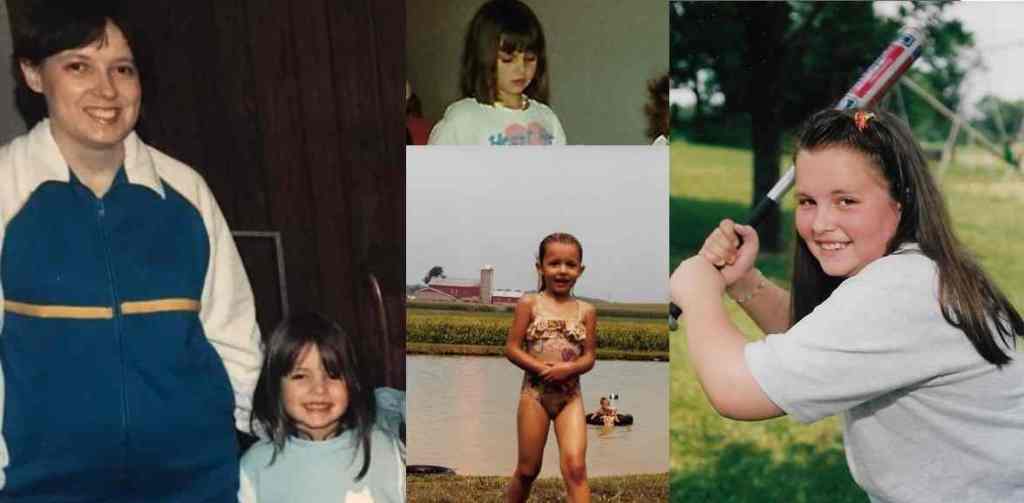
That poor child had no idea what was going on. She carried the resulting baggage into her entire life – sometimes feeding my rebellious side that decided to reject the notion of ever fitting in, other times contributing to people-pleasing tendencies, perfectionism, and so on. In fact, I found so many clever ways throughout my first forty years of life to mask and overcompensate for symptoms of my undiagnosed disorders that no one, including myself, recognized how much I was struggling and, at times, suffering. However, these self-made strategies could only carry me so far as more complicated and turbulent challenges and life changes came my way. And many of them were unsustainable and came at a great cost to my mental health and self-image.
The mood and emotional regulation issues I’ve been working through since 2018ish were heightened from stress. Still, they were always there and will remain something I must navigate. The challenges I’ve faced with productivity, task completion, and burnout since 2021 have been exceptional but also not entirely novel. I will have to find new, healthier ways to navigate my brain’s wiring in the future to successfully reach my goals or achieve my dreams.
But certainly, it will be easier to make changes and cultivate patience and understanding with myself now that I know what I’m working with. And at least to an extent, I was not entirely surprised by the diagnoses. The part of the report explaining the rationale for confirming I had Unspecified Trauma- and Stressor-related Disorder felt like a “Well, yeah, of course,” sort of moment.
If you’d told me a decade, or even five years ago, that I had ADHD, I would have been surprised because I grew up in an era where it was supposedly uncommon for girls to have and wasn’t associated with kids who were in the gifted program, like I was. But by the summer of 2023, I’d have been more shocked if the testing didn’t confirm it.
I first began to learn more about ADHD in the early 2000s as a result of my nephew’s diagnosis and both of my nieces thinking they had it. To be supportive, I investigated it occasionally. I grew surprised by the ways the symptoms differed for girls and boys and how the medical community’s presentation of the disorder had changed since I was a kid. I saw elements of it in myself, yet it didn’t feel spot-on and I only began to suspect it as a possibility in 2020 when I started seeing more depictions of the emotional regulation issues.
Even still, I didn’t have complete confidence about ADHD until the eval because I also saw elements of myself that directly contradicted ADHD’s varied presentations. In 2022, I encountered a Venn diagram made by Dr. Megan Neff (a fabulous psychiatrist, podcaster, and blogger who received late diagnoses of both ADHD and Autism) that showed the overlap and differences between ADHD and ASD. It also cited statistics about how commonly these two disorders are comorbid, which contributes to missed diagnoses because a person with both does not neatly present as one or the other.
This visual prompted my first twinge of “hmmmm, I wonder if maybe…?” Among other things, I was too organized, rigid, and into schedules, planning, structure, and routine to match the ADHD profile. Other autism symptoms that don’t impact ADHD’ers also resonated with me. As I investigated further, I became suspicious enough to raise the possibility to the neuroscientist performing my testing.
In terms of curveballs, Bipolar Disorder was the only aspect of the eval report to really raise an eyebrow. I was familiar with the disorder because a few people I know have it, including one relative. But the little I knew about it didn’t seem connected too closely to my situation, and I felt surprised. As is so often the case with things we don’t understand well, I experienced anxiety about this possibility. However, I was able to talk myself through keeping an open mind about it because until I learned so much about ADHD, I never would have guessed it was something impacting my life. I recognized that Bipolar could easily be the same deal.
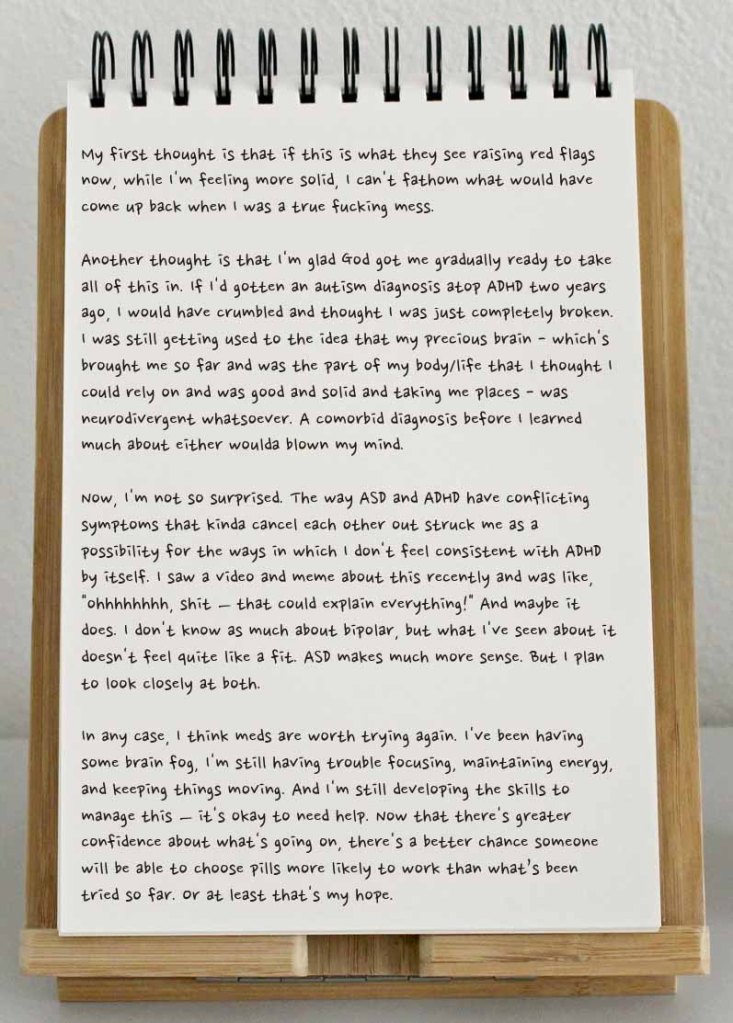
I’ll close out with this excerpt from my journal on September 7, 2023, the day that I received the evaluation report:


Amazing insight ! Good self work .
LikeLike