In Part 2 of this mini-series, I discussed why I’ve decided to forego any further diagnostic/psychiatric confirmation of whether I have Autism Spectrum Disorder (ASD). Instead, I am trusting myself (with my therapist’s support, oodles of research performed, and several self-assessments aligning) to self-determine that I am indeed autistic – and not just a little autistic, but like really actually quite frigging autistic.
As promised, this installment identifies some resources that helped me make my way toward this self-determination. Many of these were recommended by my therapist. Others came to me through friends and acquaintances who are also acclimating to recent ASD diagnoses. A few were encountered within the various resources that the aforementioned folks directed me to.
Navigating these past nine months without these helpful folks in my life would have been a much harder path. I gained comfort and peace of mind as I spoke with professionals and peers in the neurodivergent community, to the point where I eventually lost any desire for a medical professional to assign the diagnosis to me and developed the confidence needed to decide my own truth independently.
My point in sharing this is to suggest that if you are someone who is wondering if you may have ASD, do not feel like you have to A) wonder alone, or B) only engage psychiatric professionals to find the answers you are looking for. There are so many people out here muddling through the same questions who can help you find resources to dispel myths and misunderstandings, share what their experiences have been, and offer support.
You are not alone – you don’t have to figure this out all on your own.
With that pep talk in mind, check out the resources below and start exploring! I’d love to hear from you if you come across other things in your journey that aren’t included here. And if you ever want to share updates about how things are going with a co-journer, drop me a line. I can be reached at thehezhub@gmail.com or by using the contact form here.
Books, Podcasts, and More
Dr. Megan Neff – She is a fabulous psychiatrist, podcaster, and blogger who received late diagnoses of both ADHD and autism (AuDHD). Her website and Instagram feed feature countless helpful topics for someone exploring the possibility of being neurodivergent, including breakdowns of different disorders that are often confused or may overlap. Her website also links to ADHD and autism screeners.
Divergent Conversations – Dr. Neff co-hosts this podcast with another clinician who also experienced late AuDHD diagnoses. I have found listening to two mental health professionals who went undiagnosed until middle age talk about the struggles they had and continue to have really validating, plus helpful tips are often mentioned.
Unmasking Autism – Written by a late-diagnosed autistic psychologist, Dr. Devon Price’s book is framed around masking and can be a helpful read for all neurodivergents, not just autists. (Masking occurs when neurodivergents act in ways that help us pass as neurotypical or more easily blend into social settings and relationships.) Price poignantly illuminates the reasons so many of us begin to mask without even realizing we’re doing it. The book describes the strain associated with continual masking and discusses the benefits and challenges one may experience in the effort to unmask, whether permanently or selectively.
Nobody’s Normal: How Culture Created the Stigma of Mental Illness — Author and neurodiversity researcher Roy Richard Grinker is the fourth generation in his family involved in psychiatry. This book explores the cultural response to neurodiversity. It shows that there wasn’t as much stigma associated with autism and other conditions until definitions of mental illness began circulating – often in an effort to describe who was and was not considered sufficiently productive in capitalist and industrialized societies. Grinker optimistically suggests that as mental health issues continue to gain more visibility and prominence, there’s the power for change, which will eventually lead to mental illnesses becoming an accepted part of human diversity.
Peer Communities
Global and Regional Autism Spectrum Partnership (GRASP) — GRASP hosts the best autistic group meeting I have found. They don’t require a formal diagnosis to participate and welcome anyone who is, or suspects they are, neurodivergent. You don’t have to join as a member to attend the free gatherings on Monday evenings (5:30-6:30 PM Eastern). I’ve really enjoyed them and learned a lot from the folks regularly in attendance.
Autism Connection of Pennsylvania: Late Diagnosis of Autism Support Group — This virtual support group is for adults diagnosed on the autism spectrum later in life and people who believe they are autistic and don’t know where to turn for help. Meetings are held on the second Wednesday of each month (6:30-8:00 PM Eastern). While the organization is Pennsylvania-based, folks from other states often attend.
Online Assessments
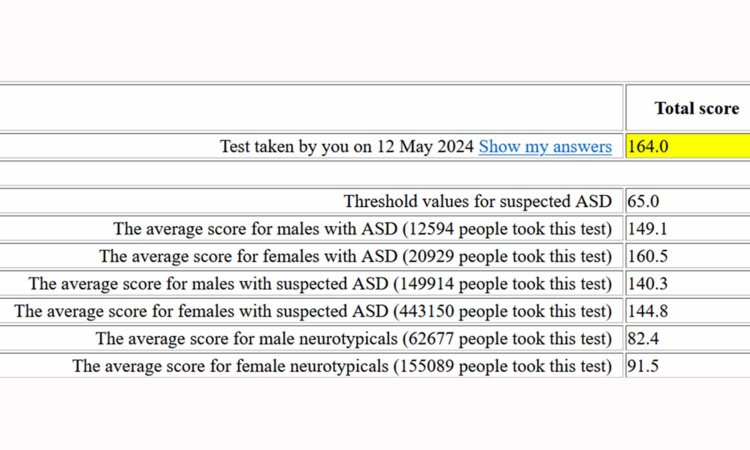
Below, you will find a list of many online assessments you can take if you are curious about whether you may be autistic. All were referred to me by credible sources (my therapist, the neuroscientist who did my eval, Dr. Neff’s website, and Dr. Price’s book). Many are the same questionnaires/scoring models that clinicians use when working with patients.
- Autism Spectrum Quotient
- Aspie Quiz
- Alexithymia Questionnaire
- Ritvo Autism Asperger Diagnostic Scale-Revised (RAADS-R)
- EQSQ — combined version of Baron-Cohen’s Empathizing Quotient (EQ) and Systemizing Quotient (SQ)
- Adult Repetitive Behaviors Questionnaire-2 (RBQ-2A)
- Camouflaging Autistic Traits Questionnaire (CAT-Q)
- Comprehensive Autistic Trait Inventory (CATI)
More Resources
There are still many other resources I’ve heard about and want to check out, so I’ll drop those here for your consideration, too:
- Is This Autism? by Donna Henderson
- Unmasked Resilience: A Strong Female Character’s Triumph Over Masked Autism by Fern Brady
- I Overcame My Autism and All I Got was this Lousy Anxiety Disorder: A Memoir by Sarah Kurchak
- Self-Care for Autistic People by Dr. Megan Neff
- Aspergirls by Rudy Simone
- NeuroTribes: The Legacy of Autism and the Future of Neurodiversity by Steve Silberman
- Divergent Mind: Thriving in a World that Wasn’t Designed for You by Jenara Nerenberg
- “Oh, That’s Just My Autism” podcast
- “Embracing Autism” podcast
- Meetup.com may help you find in-person and virtual support groups
A Word of Caution
As you begin exploring resources related to ASD, don’t take everything you encounter at face value. Unfortunately, there are still vast misconceptions about what autism is and is not, and that’s just as true in the medical community as it is in society at large. As a result, it’s to be expected that self-guided research into this neurotype will inevitably require weeding out outdated and/or false information.
There’s also an overwhelming amount of ableist shit out there about ASD that I recommend you steer clear of. I learned of this from many of the resources mentioned above. I also encountered it firsthand.
One thing I learned early on was to investigate whether autistic people held significant roles in the organization – and not just on an advisory board or committee, but rather at all levels of the organization, including leadership. Another tip is to seek out folks who promote autism acceptance, not awareness. However, there are some great organizations out there that still have awareness campaigns, too.
I’m no expert on finding the best, most reliable information on autism. But The Thinking Person’s Guide to Autism put together a list called “Useful Autism Organizations” that you may find helpful as you start to dive in.


Thank you for your knowledge and insight. What A job of research, but well done!
Aunt Jane Hobbs
LikeLiked by 1 person
Thanks for compiling and sharing all those resources!
LikeLike
I’m glad you found it helpful and appreciate you checking the post out, Elizabeth!
LikeLiked by 1 person