
Creating My AuDHD-friendly Life (Part 1)

As I wrote about in the “Relief of a Diagnosis” and “Autism Self-Determination” series, I’m relatively new to identifying as someone with AuDHD (Autism + ADHD). In the years since first suspecting and eventually confirming my neurodivergence, my process for attempting to take it in stride has gone something along these lines:

  1. Learn as much as possible about each neurotype and consider the impacts on my life, past and present.
  2. Connect with fellow neurodivergents and create a supportive community for myself.
  3. Construct a more neurodivergent-friendly lifestyle that will enable me to thrive.

As my knowledge grew from progress with #1 and #2, it became evident that I developed many coping mechanisms before my diagnoses that helped me manage my most prominent symptoms. Many were healthy, reasonable strategies, like becoming a diligent planner with color-coded calendars and orderly to-do lists. However, some were self-destructive, like using alcohol to slow down my overactive brain and lower the volume of my many intrusive thoughts. Others fall into a gray area where the impacts are slightly more ambiguous. Caffeine is a prime example.

Neurodivergence aside, caffeine is a stimulant that impacts all folks differently. I learned this firsthand in my decade+ of working in coffee shops. Some sensitive folks can’t tolerate even a drop of it, whereas others can drink it right up until bedtime. Most folks land somewhere between these extremes.

In my teens and twenties, I was an excessive coffee drinker. It was of no consequence how many shots of espresso I downed during working hours; I could still easily nap after my shift ended. Sometimes, I even experienced a reverse effect from coffee, and it seemed to make me more tired. I later learned that “caffeine naps” are not uncommon for ADHDers.

In my thirties, I began to cut back on my caffeine consumption for health reasons. I come from a long line of folks with gastroesophageal reflux disease (GERD), so acid issues were practically an unavoidable development. I first eliminated afternoon coffee, then eventually switched my morning brew to half-caff. I felt pretty happy with that compromise up until I began taking medication to manage my ADHD.

ADHD meds of all kinds, stimulants or otherwise, can be a significant variable in how your body responds to caffeine. My first prescription was for Strattera, a non-stimulant option that influences Norepinephrine receptors in the brain. In the long run, this medication was a big no for me due to a bevy of adverse side effects (which I wrote about in “Relief of a Diagnosis (Part 1)“). Caffeine further exacerbated these issues, causing my heart rate to skyrocket and frequently inducing even more severe sweats and anxiety. I became mindful of spacing out my daily French press from taking the pills, but after a 4-month adjustment period, I decided that Straterra was not the right fit for my system whatsoever.

My gastrointestinal issues were worsening around the time that I decided to give stimulants a try; between both factors, I committed to migrating from coffee over to tea. Though the negative effects aren’t as hardcore as I experienced with coffee and Strattera, even this milder beverage coupled too closely together with stimulants overloads my system. But, it’s relatively easy to space out the intake of the two. Mixing in herbal teas throughout the day is also helpful, so I still get the pick-me-up of a flavorful beverage and the pleasant ritual of brewing a drink without spiking my caffeine intake.

One big pro for tea is that many varieties have GABA, which is super for ADHDers! This article gives a good overview of what GABA is and how it works. On the caffeinated front, you can find a good amount of it in green and white teas, and this article by the amazing Dr. Neff identifies many herbal teas with loads of GABA.

On the other hand, coffee offers different health benefits. With my family’s history of non-alcoholic cirrhosis, I’m especially intrigued by its advantages for the liver. There also seems to be some evidence that it can help manage ADHD symptoms as long as there is consideration of how it interacts with meds and sleep, which my Primary Care Physician pointed out a few years back. I also just really freaking love coffee, so I mourn its absence in my life and allow myself to “cheat” by having up to seven cups per month.

I’m keen to keep learning more about this topic because I’ve had an increasing amount of sleep disruptions over the past year. I’m not sure whether to blame the medication, or how Ritalin interacts with the amount of caffeine I’m still consuming, or if it has more to do with stress and other variables. At this point, I still have more questions than answers about whether caffeine in any form can complement my current Ritalin regimen.

This lingering uncertainty is why I plan to attend a free ADDitude webinar on 2/19 titled “ADHD and Caffeine: Risks & Benefits of Using This Natural Stimulant.” It may not fill in all the blanks for me since my Autism comorbidity may create different dynamics than what will be covered here for ADHD by itself, but I expect there will still be plenty of helpful information. If you are interested in the topic but can’t attend live, you can still register to receive a link afterward to watch at your convenience.
Processing…
Success! You're on the list.

Getting the F**k Off of Goodreads

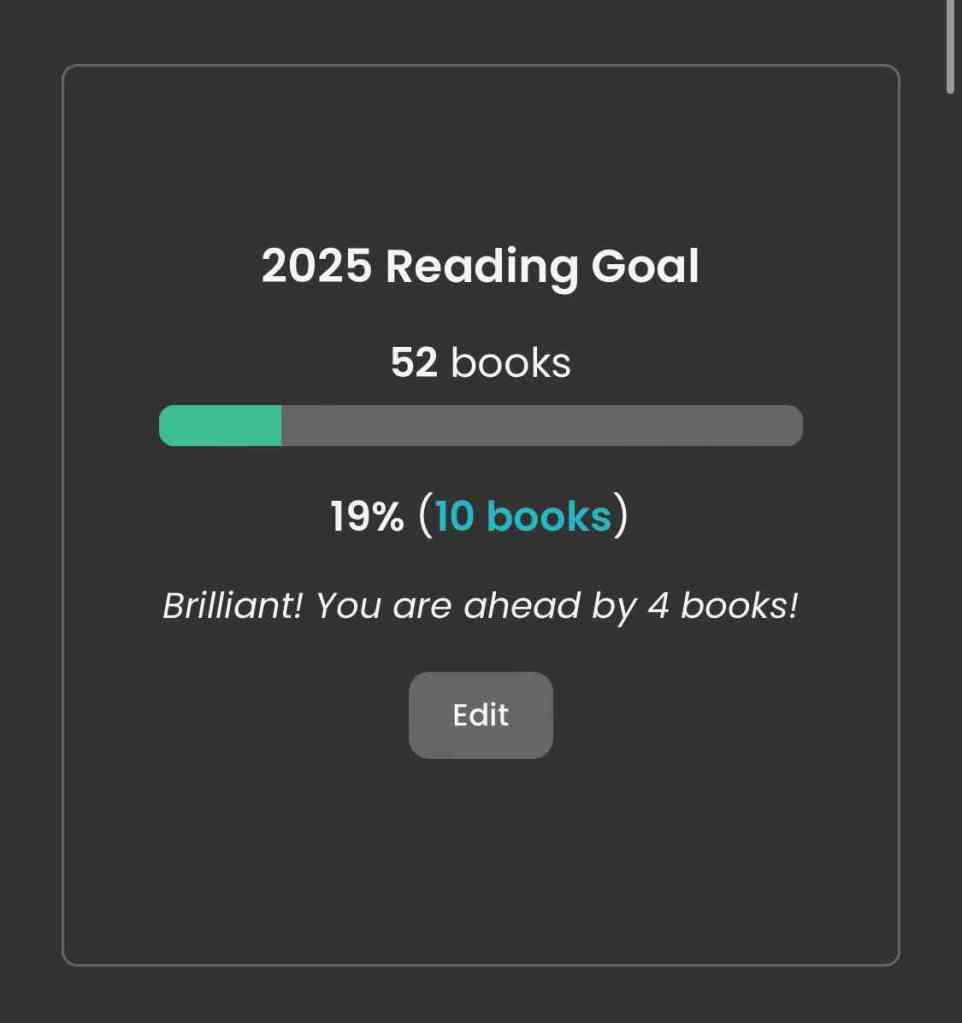
When Amazon bought Goodreads in 2013, I vowed to exit the platform as soon as possible. It took 12 years, but I’m finally making good on my word. I officially migrated to StoryGraph, and I hope you’ll consider doing the same!

For folks unfamiliar with these platforms, they each allow users to track the books they’ve read and want to read. Each has some unique features from the other, which I won’t go into exhaustively here, but there are some articles linked at the end that you may find helpful.

This move was motivated by my desire to eliminate another space where Jeff Bezos can access my data, make money off of my consumption, and force ads for Amazon products upon me. Better still, the transition to StoryGraph also supports a Black, woman-owned company!

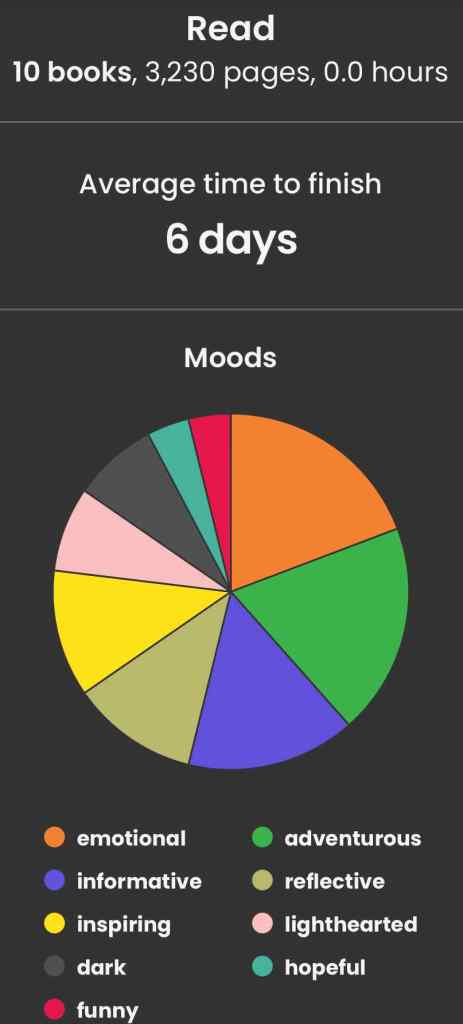
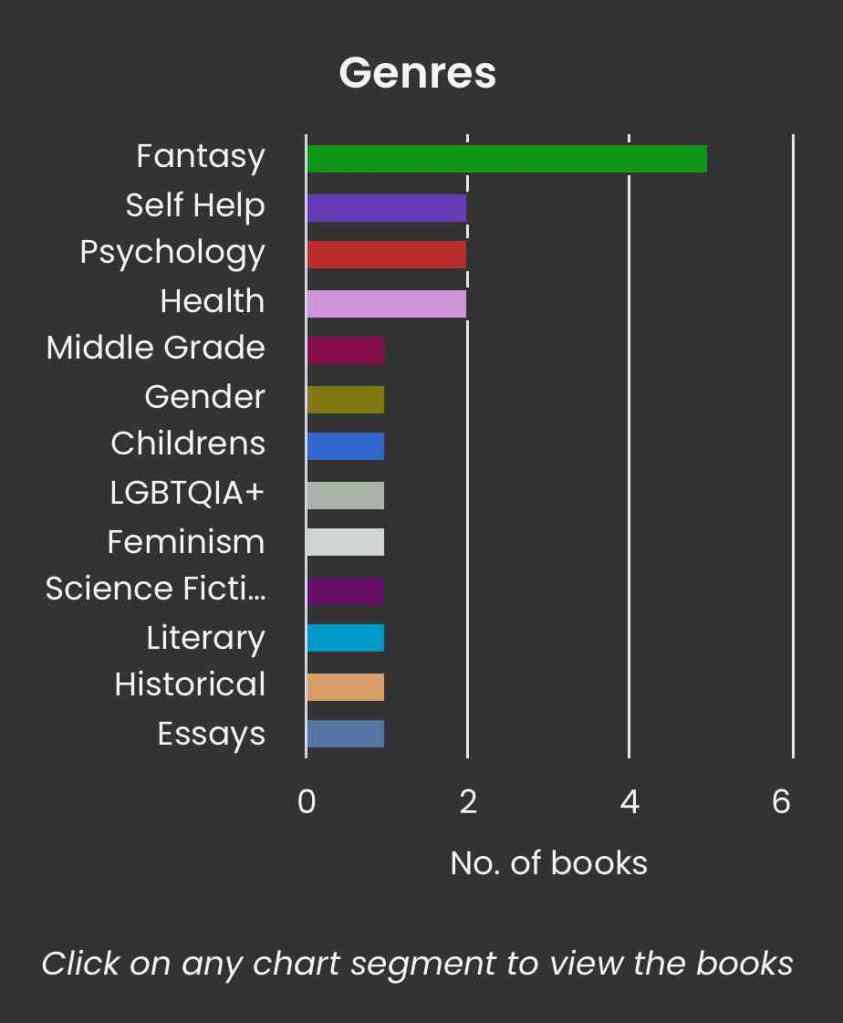
While the StoryGraph community is a bit smaller, it has truly gotten its footing in the years since launching in 2019. Even if this platform sucked compared to Goodreads, I’d still be willing to make the move at this point. But I’ve been really pleased with my experience so far, especially since they offer a lot of cool analytics and insights into personal reading trends that I’m totally nerding out about!

If you are already on StoryGraph, or decide to make the switch, I’d love to connect with you there! Here is my profile link.

For those migrating, don’t fret about losing your historical data; the process to export/import is super clear and straightforward. When you sign up for StoryGraph, they automatically share instructions on how to do so. An abbreviated version of the steps is below for reference:

On Goodreads:

  • Go to “My Books”. 
  • Click “Tools”. 
  • Select “Import and Export”. 
  • Click “Export Library” to download a CSV file. 

On StoryGraph:

  • Go to your profile page. 
  • Locate the “Import Goodreads Library” option. 
  • Select the downloaded CSV file. 
  • Click “Import my Goodreads Library” to transfer your data. 

If you want to learn more about StoryGraph and how it compares to Goodreads, check out the following articles:

Processing…
Success! You're on the list.

Preparing for the Second Trump Presidency

First, a disclaimer: This is not meant to be a political post per se. Rather, it is about my reaction to the recent US election and my contemplation over the past few weeks about how to best balance the desire to be an informed, active, and engaged citizen with my mental health needs and emotional well-being. If you’re completely past your limits on political topics, this may be worth skipping.

With that framing, I will share that I was one of the folks who woke up Wednesday, November 6, and began crying when I saw the election outcome. But it wasn’t for the reason you might think. And you may think it quite selfish, really, once I explain.

The tears didn’t arise because of the implications that Trump’s return to my nation’s highest office holds, nor what it communicates about our country to the rest of the world, though these things matter greatly whether you’re for or against the man and his party. It was actually moreso out of pity for myself. There, I said it. Whew! Not an easy thing to confess. But now that I have, please allow me to elaborate.

Since I dove wholeheartedly into my healing process and efforts to align with my purpose and values, there have been years of hard work, grieving, missteps, recalibrations, pivots, and so on. The more progress I make, the more intention and attention the journey seems to require of me. Same goes for my commitment to cultivating more compassion for myself and others, plus striving to improve my self-talk and be a gentler, more effective communicator with others. Not to mention all of the effort involved in improving self-regulation and learning how to manage my AuDHD (autism + ADHD).

In the coming four years, I anticipate that all of these areas I’ve been working on will be even more vital to my life and my place in the world, yet more challenging to succeed at with a second Trump presidency as the backdrop to whatever is happening around me. It seems inevitable that life will be requiring even more intention, attention, effort, and regulation. And frankly, I felt (and still feel) exhausted even thinking about it. 

Not hopeless, but weary. We’ll get through this, I’m sure. Just like my bus accident brought unexpected silver linings, there may even be some good that comes out of the stress and struggle – for myself, and for the country. But, damn, I don’t relish in summoning the will and courage for what lies ahead!

I was fortunate to have therapy scheduled for the same day that the results were announced and the anxiety creeping in was the main topic. In the weeks since, I’ve been giving a lot of thought to how I can navigate this better than last time. I’m wary of repeating things that I’ve learned were not healthy for me or conducive to creating a better world.

Some of the toxic shit that comes to mind from how I was moving through the world from 2016-2020 includes:

  • overdoing it on volunteer work, protests, and other forms of community action at the expense of personal goals, relationships, and my physical and mental health;
  • making hasty generalizations, succumbing to bias, and contributing to polarization with aggressive and unhelpful rhetoric; and
  • becoming drained, burnt out, angry, reactive, hopeless, and more.

“Anyone who’s interested in making change in the world, also has to learn how to take care of herself, himself, theirselves.”

Angela davis

I’m not trying to be overly self-critical here, so much as it is that I’m looking at what went down before and asking myself a lot of really tough questions:

  • What will I do differently this time?
  • How can I keep working to be healthier and happier in my personal life while fear, anxiety, and suffering surround me?
  • How can I pace myself?
  • How can I keep perspective that every pursuit can be an act of resistance, like even just showing care for my body by remembering to floss?
  • How can I build bridges instead of divides?
  • How can I give myself and others grace — and I mean all others, not just the Blue Team folks — as we try to do our best and misstep along the way?

Instead of throwing my life into complete upheaval trying to save the damn world, I’m hoping to find more balance and:

  • prioritize my health and well-being
  • continue to work on my personal life and goals
  • build bridges instead of divides
  • bring love to every single thing I do

“Caring for myself is not self-indulgence. It is self-preservation and that is an act of political warfare.”

Audre Lorde

In November, Patti Smith published a short lovely video in reference to the post-election energy. You can watch “A few words” on Substack, if you’d like. My favorite part is below.

Do not feel cornered, hemmed in. Do not let your mental and heart space be dictated by others.

Lots to think about as I brace for the impact of today’s inauguration and the years to follow. But, as Patti said, I am not cornered. I don’t have to do any specific thing right now or change my course or let other people/situations determine how I move through the world. The same goes for you too.

Last month, I took Patti’s closing statement in this video as a gentle nudge to move on from anxiety. “Back to work,” she said. Indeed.

Processing…
Success! You're on the list.

Lessons in Recovery (Part 1)

When I first heard the term “codependent,” I didn’t think much of it. I was independent—so very independent—maybe more than a tad hyper-independent. Certainly not codependent, whatever that was.

I associated the term with mushy, enmeshed couples whose lives revolve solely around one another—you know, the ones who have no interests outside of their romance—or extreme examples of maladaptive parents who raise their children to be reliant on them well into adulthood. I, on the other hand, had learned to rely solely on myself and maintained the practice with great rigidity in pretty much all of my relationships.

It wasn’t until I really dove into my mental health journey over the past six years that I began to learn more about codependence. There are differing opinions on its definition, but the one below is fairly broad and, therefore, felt uncontentious to share.

Codependency [is] a pattern of compulsive behaviors that is motivated by a dependence on another’s approval and is designed to find a sense of safety, identity, and self-worth. An essential characteristic of someone who is codependent is that they continually invest their self-esteem in the ability to control and influence behavior and feelings in others, as well as in themselves, even when faced with adverse consequences such as feelings of inadequacy after failure.

Journal of Mental Health Counseling

As I began to understand attachment theory better, it was a revelation to discover the vast array of ways that codependence manifests and to begin recognizing it so readily in myself. It turned out that stubbornly clinging to my independence and need for control was one of many toxic distortions that codependence created within me.

As I began to speak more often with my therapist about codependence and recurring relationship issues, she eventually recommended trying out Codependents Anonymous (CoDA). Founded in 1986, CoDA is a 12-step program for people who share a common desire to develop functional and healthy relationships. CoDA distributes resources, such as the CoDA Blue Book (akin to Alcoholics Anonymous’s Big Book), and hosts countless virtual and in-person peer support groups.

Though their website’s references to a “Higher Power” and the 12-step program model made me wary—both for reasons too involved to discuss here—I eventually overcame my misgivings. I persuaded myself to move forward based on my trust in my therapist. I knew she would never refer me to an unsafe space or encourage me to continue participating in CoDA if it didn’t feel like the right fit.

I’ve also had many positive experiences with group work and peer-to-peer forums over the past few years. Even in a few situations where I didn’t necessarily agree with all aspects of an organization’s agenda, I was still able to learn a lot and make authentic connections. These past successes further encouraged me to try and keep an open mind.

My first meeting was January 8, 2024 ­— which makes today what is referred to as my “CoDA birthday” — so, obviously, I’ve felt favorably about my involvement so far!

Since I like my mini-series so much, this anniversary is a good prompt to launch another one on topics related to codependence. For example, explaining what helped me feel comfortable diving in with CoDA, key lessons learned in my first year of recovery, surprises and struggles along the way, and sharing resources I’ve found helpful.

I’ll save all of that for future installments, though. For now, I just want to pause and bask in how tremendously proud I am of reaching this milestone. It’s so rare for me to give myself credit for my progress and the commitment and resolve it has required. So, for today: Happy CoDA birthday to me, indeed! More to come after I’m done basking in this milestone.

Processing…
Success! You're on the list.

Silver Linings of Being Hit by a Bus (Part 2)

In Part 1 of this series, I explained that it took a really long time, but some silver linings did finally emerge from getting hit by a city bus in 2008. (You can learn more about the accident in the “Local Woman Hit By Bus” series.)

The bus accident and its fallout taught me a great deal about who I was. It also provided me with an opportunity to reflect and gain insight into how I’d become that person. Taking stock like this in some areas of life was far from comfortable, and it became evident that new ways of thinking and being were needed.  

Unlearning a Myth

In Part 1, I discussed how the bus accident motivated me to become a physically active person invested in their health and well-being. My transformation into an outdoorsy and fit person was a stark contrast to how inactive my life was before the accident. Aside from having a bustling service industry job, I did very little to stay fit or healthy.

Not only did I lack any sort of exercise regiment, I actually thought I loathed physical exertion. Before the bus accident, there was only one activity that I was willing to sweat for by choice, which was going out dancing at raves and clubs. But this impression I didn’t enjoy movement was false, and the immense joy I experienced while bopping around dance floors at raves and hip-hop clubs was my first clue. Today, I am an avid hiker and cyclist who appreciates many other forms of movement, like qigong, yoga, and swimming. I also make it to the gym regularly to keep up with weight lifting and circuit training.

This significant shift in my identity, how I viewed my body’s abilities, and the satisfaction I felt when in motion begs the question: Where did this mistaken impression that I hate physical movement originate?

The answer is as simple as two words: gym class.          

Let it suffice to say that the recurring humiliation I endured as an overweight kiddo in a teeny-tiny town’s physical fitness program was a clear turn-off to all things physical from an early age. I purposely “forgot” my uniform at home on gymnastics days. I began to view all of the activities as stupid and beneath me so it was more convincing (to myself and others) when I acted like it didn’t bother me to be the last one picked by either captain when the class split up into teams. I would sometimes pretend I was sick and miss school entirely to avoid having to run the mile with my classmates, who offered snickers and comments as they awaited my finish. Even imagining that track and the final lap with 20+ adolescent eyes trained on me makes me cringe.

But yeah, anyway—it turns out that I don’t hate physical activity. Becoming someone so incredibly active, as discussed in Part 1, made me realize how much I let the bullying of my peers throughout adolescence impact my understanding of myself and create the false belief that I didn’t like movement or exercise at all. That turns out to have just been an aversion to being perceived while performing physical acts as a result of trauma.

Though I am working to overcome it, this avoidance of using my body in front of others continues to be a part of my internal wiring. It doesn’t typically impact me with hiking or biking, though I sometimes get self-conscious when struggling up hills. But class settings, like hitting up a yoga studio, remain touchy for me even though I’m familiar with the poses and confident that no one is there to pay attention to me, let alone make fun of me!

While I wish I’d never developed such an extreme sense of body shame and self-consciousness, I’m grateful that I became aware of its existence within me. I’m even more appreciative that I was able to tear down this arbitrary barrier to physical movement and overcome my aversion enough to take care of my body so it could heal and recover from the accident.

The necessary mindset shift that made this possible was fueled by my desire to escape ongoing chronic pain and avoiding back surgery. But eventually I reached a point where physical activity genuinely brought me joy and happiness. Who knows whether I ever would have expanded my definition of who I am in this way without the impetus of that dang bus? So, again, like I said last time: thanks, bus…I guess?

Processing…
Success! You're on the list.

Silver Linings of Being Hit by a Bus (Part 1)

After becoming the “Local Woman Hit By Bus” in 2008, I faced a lot of difficulty in the recovery process. Chronic pain, uncertainty of how well I may heal, financial insecurity and accruing debt, struggling to find a lawyer to take the case, fighting the bus company, and so on. At times, the stress broke me down in ways I didn’t even know were possible. While all of that trauma is certainly an important part of the story, this series is instead focused on the silver linings that (eventually) emerged.

Don’t get me wrong. I’ll never say the bus accident was a good thing. Or that I’m glad that it happened. Or everything happens for a reason. But over time, I’ve come to believe that there are always seeds planted in every terrible thing that happens in this world. That was certainly the case for me with the bus accident. It took a really long time to find anything positive in the situation, aside from immediate relief and gratitude for not being dead, of course! But eventually, goodness made its way to me in several forms that I’ll cover in a few posts.

Getting Active

Before the accident, I was not focused on my health at all. I’d sought after losing weight and trying to get “skinny” most of my life, but otherwise had zero goals or efforts in place for wellness. I was barely physically active aside from occasional nights out dancing at music events and working full-time in a bustling coffee shop that kept me on the go.

Fast forward to today: I am now an avid hiker and cyclist. I taught myself how to swim in my thirties. I regularly do weight and resistance training. I dabble in mindful movement (yoga, qigong, somatic exercise).

Essentially, I became motivated to take care of my body by way of a heavy realization: I had to keep moving if I wanted to keep moving.

In the early days of healing, I discovered that slacking on my physical therapy exercises or taking even a single day off of stretching quickly resulted in pain and setbacks. Even when I was completely on top of things and doing my part, I’d experience debilitating flare-ups out of nowhere, like the day I tweaked my back while bending over to pick something up from the floor.

As I developed more consistency in tuning into and taking care of my body’s heightened needs, I began to see steady progress. The flare-ups didn’t last quite so long when they came, and they began arising less often too.

I don’t recall how long it took, but I eventually realized that I enjoyed exercise and moving my body. (More on this epiphany in the next installment.) At the same time, though, I was getting bored with dragging myself to the gym and doing the same exercises all the time. (Hello, ADHD!)

That’s when I started mixing in more walking. This soon led to hiking, because if you’re going to walk, why not do it in the woods? The bike purchase came soon after at the suggestion of my ex. Then, I finally figured out swimming, thanks to the help of my niece, who had recently learned and possessed a knack for breaking it down in a way I could understand.    

This week alone, my Fitbit has tracked 139 zone minutes per day, which is pretty close to the amount of moderate activity recommended by the American Heart Association for an entire week (150 minutes)! At 41, I can easily ride my bike up to 50 miles, hike up to 20 miles, and go out dancing for hours. I am in better shape now than I was at 14 or 24, and I am grateful every day for my body’s abilities.

Truly, I have the bus accident to thank for this transformation, though it was hardly a pleasant push toward better health. Still…thanks, bus…I guess?

Processing…
Success! You're on the list.

Autism Self-determination (Part 3)

In Part 2 of this mini-series, I discussed why I’ve decided to forego any further diagnostic/psychiatric confirmation of whether I have Autism Spectrum Disorder (ASD). Instead, I am trusting myself (with my therapist’s support, oodles of research performed, and several self-assessments aligning) to self-determine that I am indeed autistic – and not just a little autistic, but like really actually quite frigging autistic.

As promised, this installment identifies some resources that helped me make my way toward this self-determination. Many of these were recommended by my therapist. Others came to me through friends and acquaintances who are also acclimating to recent ASD diagnoses. A few were encountered within the various resources that the aforementioned folks directed me to.

Navigating these past nine months without these helpful folks in my life would have been a much harder path. I gained comfort and peace of mind as I spoke with professionals and peers in the neurodivergent community, to the point where I eventually lost any desire for a medical professional to assign the diagnosis to me and developed the confidence needed to decide my own truth independently.

My point in sharing this is to suggest that if you are someone who is wondering if you may have ASD, do not feel like you have to A) wonder alone, or B) only engage psychiatric professionals to find the answers you are looking for. There are so many people out here muddling through the same questions who can help you find resources to dispel myths and misunderstandings, share what their experiences have been, and offer support.

You are not alone – you don’t have to figure this out all on your own.

With that pep talk in mind, check out the resources below and start exploring! I’d love to hear from you if you come across other things in your journey that aren’t included here. And if you ever want to share updates about how things are going with a co-journer, drop me a line. I can be reached at thehezhub@gmail.com or by using the contact form here.

Books, Podcasts, and More

Dr. Megan Neff – She is a fabulous psychiatrist, podcaster, and blogger who received late diagnoses of both ADHD and autism (AuDHD). Her website and Instagram feed feature countless helpful topics for someone exploring the possibility of being neurodivergent, including breakdowns of different disorders that are often confused or may overlap. Her website also links to ADHD and autism screeners.

Divergent Conversations – Dr. Neff co-hosts this podcast with another clinician who also experienced late AuDHD diagnoses. I have found listening to two mental health professionals who went undiagnosed until middle age talk about the struggles they had and continue to have really validating, plus helpful tips are often mentioned.

Unmasking Autism – Written by a late-diagnosed autistic psychologist, Dr. Devon Price’s book is framed around masking and can be a helpful read for all neurodivergents, not just autists. (Masking occurs when neurodivergents act in ways that help us pass as neurotypical or more easily blend into social settings and relationships.) Price poignantly illuminates the reasons so many of us begin to mask without even realizing we’re doing it. The book describes the strain associated with continual masking and discusses the benefits and challenges one may experience in the effort to unmask, whether permanently or selectively.

Nobody’s Normal: How Culture Created the Stigma of Mental Illness — Author and neurodiversity researcher Roy Richard Grinker is the fourth generation in his family involved in psychiatry. This book explores the cultural response to neurodiversity. It shows that there wasn’t as much stigma associated with autism and other conditions until definitions of mental illness began circulating – often in an effort to describe who was and was not considered sufficiently productive in capitalist and industrialized societies. Grinker optimistically suggests that as mental health issues continue to gain more visibility and prominence, there’s the power for change, which will eventually lead to mental illnesses becoming an accepted part of human diversity.   

Peer Communities

Global and Regional Autism Spectrum Partnership (GRASP) — GRASP hosts the best autistic group meeting I have found. They don’t require a formal diagnosis to participate and welcome anyone who is, or suspects they are, neurodivergent. You don’t have to join as a member to attend the free gatherings on Monday evenings (5:30-6:30 PM Eastern). I’ve really enjoyed them and learned a lot from the folks regularly in attendance.

Autism Connection of Pennsylvania: Late Diagnosis of Autism Support Group This virtual support group is for adults diagnosed on the autism spectrum later in life and people who believe they are autistic and don’t know where to turn for help. Meetings are held on the second Wednesday of each month (6:30-8:00 PM Eastern). While the organization is Pennsylvania-based, folks from other states often attend.

Online Assessments

Below, you will find a list of many online assessments you can take if you are curious about whether you may be autistic. All were referred to me by credible sources (my therapist, the neuroscientist who did my eval, Dr. Neff’s website, and Dr. Price’s book). Many are the same questionnaires/scoring models that clinicians use when working with patients. 

More Resources

There are still many other resources I’ve heard about and want to check out, so I’ll drop those here for your consideration, too:

  • Is This Autism? by Donna Henderson
  • Unmasked Resilience: A Strong Female Character’s Triumph Over Masked Autism by Fern Brady
  • I Overcame My Autism and All I Got was this Lousy Anxiety Disorder: A Memoir by Sarah Kurchak
  • Self-Care for Autistic People by Dr. Megan Neff
  • Aspergirls by Rudy Simone
  • NeuroTribes: The Legacy of Autism and the Future of Neurodiversity by Steve Silberman
  • Divergent Mind: Thriving in a World that Wasn’t Designed for You by Jenara Nerenberg
  • “Oh, That’s Just My Autism” podcast
  • “Embracing Autism” podcast
  • Meetup.com may help you find in-person and virtual support groups 

A Word of Caution

As you begin exploring resources related to ASD, don’t take everything you encounter at face value. Unfortunately, there are still vast misconceptions about what autism is and is not, and that’s just as true in the medical community as it is in society at large. As a result, it’s to be expected that self-guided research into this neurotype will inevitably require weeding out outdated and/or false information.

There’s also an overwhelming amount of ableist shit out there about ASD that I recommend you steer clear of. I learned of this from many of the resources mentioned above. I also encountered it firsthand.

One thing I learned early on was to investigate whether autistic people held significant roles in the organization – and not just on an advisory board or committee, but rather at all levels of the organization, including leadership. Another tip is to seek out folks who promote autism acceptance, not awareness. However, there are some great organizations out there that still have awareness campaigns, too.

I’m no expert on finding the best, most reliable information on autism. But The Thinking Person’s Guide to Autism put together a list called “Useful Autism Organizations” that you may find helpful as you start to dive in.

Processing…
Success! You're on the list.

Autism Self-determination (Part 2)

In my last post, I described ways that I explored the possibility that I have Autism Spectrum Disorder (ASD) in addition to ADHD and an Unspecified Trauma- or Stress-related Disorder. I now have high confidence I am indeed autistic – and not just a tad on the spectrum, but actually at the higher end of symptoms exhibited.

After much consideration, I am choosing to self-determine instead of continuing to seek a professional diagnosis of this condition. In the way I am using the term, self-determination for me right now means:

  • I am self-diagnosing with authority. I will no longer tell people I “might” have autism or my care team “suspects” I could be on the spectrum. As far as I am concerned, I am autistic without question unless something significant changes in my mental state or the scientific knowledge about ASD.
  • While my team of mental health care providers will offer input and support, I consider myself at the helm of choosing how I will “treat” this condition. (The use of quotation marks here reflects my growing belief that being AuDHD is not a disorder, but rather just a different neurotype than most people – more on this in a future post!)
  • I am empowering myself to decide on a case-by-case basis when I will or won’t disclose that I’m autistic. Not because it’s a secret or I’m ashamed, but because it’s not a dialogue I feel is necessary in every setting of life. I’m also learning about the potential risks of being too open about it in certain situations.

Many factors went into my decision-making process for self-determination. This choice is the best one for me right now, but I am not advocating that others do the same.

If you choose to, I urge you not to approach the undertaking lightly. With nearly one-third of folks in the US self-diagnosing a myriad of health conditions based on online research, mistakes are certainly likely given how many conditions have closely overlapping symptoms.

There’s also the possibility of basing self-diagnosis on false information in heavy circulation. Case in point: a recent study found that only 27% of the most popular TikToks about autism are based on reliable information, and 41% were entirely inaccurate.

If you suspect you have ASD, there are many considerations to take into account before deciding whether to work with a medical practitioner for a diagnosis. I will touch on some of these below as I explain what was on my mind before I reached my own conclusions about how to move forward. At the end, I’m also linking a few articles that discuss the matter of self-diagnosis.

“The tendency to look for a diagnosis to explain any variations in personality and behavior takes away from accepting normal variety among children and adults, and minimizes the significance of living with a significant disorder that impacts many aspects of the person’s life.”

Diane Franz, ph.d.

Degree of Certainty

In the first part of this series, I explained all of the methods I used to learn more about autism and explore whether it seemed like a possible fit for me. This was a significant investment of time and energy.

I involved medical professionals throughout the journey from curious to suspicious to leaning in the direction that I was autistic to eventually becoming convinced. A valid neuropsychological assessment identified my symptoms as being consistent with the disorder; results that were then confirmed repeatedly by every online assessment my therapist recommended and I dug up.

It is difficult to eliminate the possibility of mistaken diagnoses as a result of the complex interplay between our mental health, brain chemicals, and overall functioning. But to the best of my ability, I have addressed every other possibility with the input of qualified professionals who support my assessment.

A 2015 study found that self-diagnostic assessment tools can be quite accurate and effective for autistic people, suggesting they can be trusted to know themselves, do thorough research, and self-assess their understanding of what it means to be autistic.”

Olivia Guy-Evans, MSc

Barriers to Seeking Diagnosis

Even if I wanted an official ASD diagnosis, there are countless obstacles to attaining one. The first challenge is finding a clinician without a massive waiting list. US families typically wait an average of three years before getting their children successfully diagnosed and few evaluators even offer ASD assessments for adults.

Then there’s the matter of cost. Even with insurance, it’s likely that only negligible portions of the expenses will be covered, and the average price ranges from $1,000-2,000. Many self-diagnosed autists consider a formal diagnosis a privilege, whether they would like one or not.

Another concern is that clinicians who perform evaluations often lack experience diagnosing and treating neurodivergent people. It’s even harder to get accurate diagnoses for women, who may not match the traditional diagnostic criteria that were developed based primarily on research of cisgender white males and/or children. Because many individuals don’t conform to preconceived notions of what autism is, many autists experience a myriad of misdiagnoses. This can create trauma and distrust of the medical community, which makes self-diagnosis all the more appealing.

Benefits of a Diagnosis

Folks who pursue diagnoses for mental health issues may be motivated by ensuring they’re receiving appropriate medication and/or treatment to resolve the issue. However, autism does not have a cure; it is a lifelong condition. Nor are there any medicinal treatments for it, though some prescriptions may be used to help manage specific symptoms (e.g., the only two FDA-approved drugs for ASD children may help with irritability and/or aggression).

Other motivators are not relevant to my situation or compelling enough to persuade me to invest further into pursuing a diagnosis. For example, I have low support needs, and I’m not seeking approval from social benefit programs or elsewhere to access services or protection under the Americans with Disabilities Act. Even if I had interest in disability services and legal protection, my ADHD diagnosis already covers my right to request accommodations in workplaces or other institutional settings.

I am also fortunate to have an open-minded network of folks who don’t dispute my decision or challenge me in ways that drive me to seek professional validation. The people most important to me support my process and don’t question the validity of my self-diagnosis.  

Risks of a Formal Diagnosis

It’s important to know that there are situations in which having a documented ASD diagnosis can become a liability:

  • If you have a guardian or conservator, bear in mind that your health information can be shared with them without your permission.
  • Having ASD on record may influence how your healthcare providers approach your care; they may underestimate your abilities or be influenced by their own misunderstandings about autism.
  • Before Obamacare made it illegal for insurance companies to raise rates or drop patients with pre-existing conditions who were considered high-risk, an ASD diagnosis could result in being denied or losing coverage. While this hasn’t been the case since 2014, we’ve all seen how swiftly politicians can dismantle past protections and replace them with new policies.
  • Being diagnosed may impact immigration eligibility to certain countries. For example, there are cases where relocating families were granted visas for everyone except the autistic member. Counties may also deny residency if an ASD person’s medical treatments exceed their medical cost threshold.
  • While the US military doesn’t outright ban autists from joining, ASD is considered a “disqualifying condition.” Recent data shows only about 500 out of 1,800 autistic applicants received approval for a medical waiver.
  • While autistic folks are permitted to adopt or foster children in the United States, having a diagnosis can lead to additional screening and bias may influence whether you are deemed eligible.
  • Parents with disabilities often face discrimination, and they are less likely to be awarded custody or visitation rights. They can be required to perform a parenting assessment, which may be performed by evaluators lacking experience with ASD and become a deciding factor in settling disputes between parents.

Recognizing My Privilege and Blessings

It has been an essential part of my journey in these past few years to explore my mental health and work extensively with medical professionals to get accurately diagnosed. I reached the finish line with ADHD and now feel comfortable stopping short on the ASD front. Who knows, though, maybe I’ll change my mind about this in the future.

In the interim, I recognize that the only reason I have a choice in whether to get diagnosed or disclose my condition is because I am incredibly privileged and blessed. ASD is truly a spectrum. While 26.7% of autists are considered as having profound autism, I have low support needs. My dual condition offers me access to the few accommodations I have an interest in without needing ASD verified. Being a white cis woman offers me social standing that supports more comfort in requesting accommodations as needed and increases the chance my requests will be met. And I’m fortunate to have a great support network and access to supportive, neurodivergent-friendly medical professionals.

Resources

The list below is far from exhaustive, but may be helpful:

Processing…
Success! You're on the list.

Autism Self-determination (Part 1)

As I wrote about in the “Relief of a Diagnosis” series, my neuropsychological evaluation in the summer of 2023 confirmed that I had ADHD and Unspecified Trauma- or Stress-related Disorder. Still, it left open the question of whether I may be autistic, bipolar, neither, or both. In this post, I describe ways I explored the possibility of Autism Spectrum Disorder (ASD) in the 10 months since getting the results.

Pooling Resources

As a constant learner, I immediately turned to the library and the internet to review countless books, articles, podcasts, and more to learn more about ASD and its interplay with ADHD. In a future blog post, I will share a list of these for anyone interested.

A key takeaway was that until recently, having an ASD diagnosis precluded receiving an ADHD diagnosis and vice-versa; the myth that it was impossible to have both is now thoroughly debunked. It turns out that there’s actually a significant number of folks with comorbidity of the two disorders. The estimates of a dual diagnosis vary, but some figures commonly circulating suggest that 20-50% of people with ADHD also have ASD, and 40-70% of people with ASD have ADHD. While more research is needed to explain why this is, overlapping contributing genetic factors have become well-documented and may be a factor.

While approximately 10% of the population has ADHD, some research has shown that 40% of autistic people have ADHD, with other studies suggesting that the rate may be closer to 70%.

Conversely, while 2-3% of people are autistic, 20-50% of those with ADHD are also autistic.

Amy Marshall, PsyD

Talking to Family and Peers

In neurodiverse (ND) communities, it is often joked that we have radar that attracts us to other ND folks. Many memes suggest that if you are friends with a bunch of people who have ADHD, ASD, etc, it’s probably time to seek your own diagnosis. While science doesn’t entirely back this up just yet, there is research about how neurodivergents relate in social settings that suggests we may find more symmetry and common ground in our communication style that can facilitate forming bonds more quickly than we experience with neurotypicals.

Regardless of this claim’s validity, I have discovered a growing number of NDs within my network. A few (all boys) were diagnosed in childhood, but most flew under the radar into adulthood like myself. I also have several relatives on both sides of my family who are diagnosed with ADHD, a handful of whom suspect they are also autistic.

Eventually, I found a few online communities and support groups that connected me with even more NDs (a list of these will also be included in a future post). While learning about ASD traits in books and so on was undoubtedly helpful, it was comparing my life experiences with these folks and hearing about their journey to an ASD diagnosis that tipped me over into finding the prospect reasonably likely that I was autistic. 

Professional Help and Self-Assessments

After months of research, exploration, conversation, and soul-searching, I felt pretty confident I had ASD. I spoke with my therapist and Primary Care Physician throughout this period about my observations and received positive feedback about my thought process.

When I expressed an interest in establishing a bit more certainty, my therapist provided an extensive list of free online self-assessments that mirror the instruments used by psychiatrists and neuroscientists in the field (yet another list to look forward to in an upcoming post). She suggested that while I did not need consistent results from every single one identifying me as over the threshold for suspected ASD, there should at least be a considerable trend of results heading in that direction.

I spent a few weeks diligently taking each of these, and here’s what I learned: it appears that I’m not just mildly, or even moderately, autistic – I’m very freaking autistic!

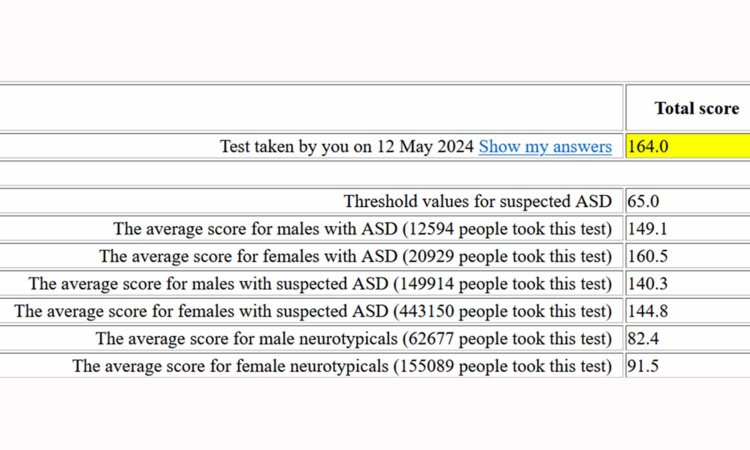
Not only did every single one of the assessments place me above the threshold for suspected ASD, but many identified me as displaying significantly more than average amounts of autistic traits. For example, the Aspie Quiz resulted in a 98% probability of being autistic. The Ritvo Autism Asperger Diagnostic Scale-Revised (RAADS-R) deems any score greater than 65.0 as worthy of considering an ASD diagnosis; my score was 164.0. Not only did I crush the threshold, but this score is even higher than the average score for females diagnosed with ASD (160.5).

The various benchmarks of my assessments align with the findings of my neurospych eval testing, which documented my responses as being “significantly above established thresholds consistent with Autism Spectrum Disorder-related symptoms.” Further, several aspects of my self-reporting reflected sensory motor issues, social anxiety, an interpersonal style that may be somewhat distant, and circumscribed interests (restricted and repetitive behaviors that occur commonly in individuals with ASD).

Moving Forward

Autism is widely misunderstood. Until I began to learn more about it, I never would have guessed I had it. Now I am equipped with far more information, oodles of assessment results backing up the suspected diagnosis, and the encouragement of my care team validating my suspicions.

Despite my now high confidence that I am autistic, I’ve decided not to pursue a formal diagnosis further. Instead, I am choosing to self-determine my diagnosis and plans for how to manage the condition. In a future post, I will explain why I settled on this path forward and the input/feedback I received from my therapist.

Processing…
Success! You're on the list.

National Volunteer Week

April 21-27 is National Volunteer Week, which invites us all to recognize the impact of volunteer service and how people power helps tackle societal issues and build stronger communities.

I grew up in a family that contributed a great deal of time to serving our community, so volunteerism is an ideal near and dear to my heart. My mom and dad often taught Sunday School and regularly supported other church events. My dad was a Volunteer Assistant Fire Chief and EMT who risked his life to serve his community. Even after he passed, leaving my mom to raise three girls alone, she continued giving back by chaperoning events at my school and organizing a Saint Jude’s Bike-a-thon. My extended family is also full of altruistic folks who actively support all manner of causes.

I didn’t dive too deeply into service work until my late twenties, but it became a cornerstone of my life once I found my way to it. I thought this weeklong observance was the perfect opportunity to share a little bit about why I invest my time and energy in this way and ways you might begin to do the same if you’re interested.

Benefits of Volunteering

Although the goals of helping others or improving the world are undoubtedly good motivators for volunteering, there are many other benefits I’ve experienced from getting involved in my community and supporting causes I believe in.

Valuable skills: I once transitioned from a job involving many community outreach activities to a very desk-based, isolating role, so I began signing up for volunteer shifts tabling at events to keep my social engagement skills sharp. In addition to maintaining skills, volunteer work allowed me to develop new ones and grow into organizational leadership roles, such as becoming a committee chair and board president.

Sense of purpose: Volunteering nearly always provides warm, fuzzy feelings. My drive to be involved in my community was particularly activated during the Trump years when divides in our country were widening amidst significant social problems and upheavals. I knew I couldn’t solve all of the world’s problems and found it challenging not to get sucked into all of the negativity, drama, and tension. Volunteering more during that period helped me channel my concerns and frustrations into positive action. It offered the satisfaction of feeling like I was doing my part to create the future I wanted to see.

Improving my mental health: Research in the past decade has uncovered a correlation between volunteering and happiness. There is also evidence that giving back can reduce stress, anger, and anxiety.

Social connections: Studies have also shown that volunteering helps people feel less isolated and reduces loneliness. I have met countless wonderful folks throughout my volunteer efforts. Some became friends, others supported me in job hunts, and many are just friendly faces I enjoy seeing when I bump into them in other areas of life.

“Volunteering is one of the best, most certain ways we can find a purpose and meaning in our life.”

Val Walker

Ways to Get Involved

People often ask how I find volunteer opportunities. What worked well for me initially was to consider all of the buckets of causes I wanted to support and find one organization per cause that I could help in some way. At first, it was pretty casual, with most of my commitments being one-off events or projects that didn’t require ongoing involvement or significant responsibilities. Eventually, I felt up for a bigger challenge and began getting involved with board service.

I recommend a few methods for finding volunteer opportunities. Suppose you already like and support particular organizations. In that case, you might start by checking whether their website has listings for volunteer opportunities. If not, find an email address or use the contact form to reach out and inquire directly about service opportunities.

Another method is to check job boards since many sites that post professional openings also have listings for volunteer opportunities, e.g., Indeed and Idealist. There are also volunteer matching websites that promote volunteer openings and offer search filters to identify opportunities that best fit your skills, interests, and schedule availability.

Considerations in Choosing Opportunities 

As you investigate volunteer openings, you’ll discover a wide range of time commitments, schedule flexibility, level of responsibility, skills required, and the effort needed to sign up.

Below are some questions to help guide your considerations in evaluating what types of volunteer opportunities are going to be the right fit for you:

  • How much time per [week/month/quarter] am I willing to commit to volunteering?
  • What are my preferences around synchronous vs. asynchronous service work?
  • What are my preferences around remote vs. in-person service work?
  • What nonprofits and/or causes am I interested in supporting?
  • What skills am I most interested in contributing?
  • What types of work am I open to doing (e.g., physical labor, admin tasks, specialized skills)?
  • Do I want to commit to a recurring schedule, or will signing up for one-off opportunities work better for my schedule?

Processing…
Success! You're on the list.